Este artículo se publica únicamente en inglés.
In a Jaipur shop you will hear all three words in the same sentence, usually in the phrase "kundan polki jadau", said quickly, as though they were one thing. They are not one thing. They describe a stone, a material and a technique, and once you can separate them you can tell a great deal about a piece before anyone tells you anything.
Polki is a stone
Polki is natural diamond that has not been faceted in the modern sense. It is either a flat slice sawn from a crystal, or a rough crystal with its natural surface — its skin — left more or less intact and only lightly worked.
This matters because it is a completely different aesthetic proposition from a brilliant cut. A brilliant is engineered to return light to the eye: fifty-seven facets arranged so that light entering the top is bounced back out of the top. Polki does almost none of that. It has depth, a slightly milky interior, and it sits somewhere between a stone and a window. In candlelight, which is what it was originally worn in, it glows rather than sparkles.
It is a real diamond. That is worth saying plainly, because the word is frequently applied to glass, to quartz, and to cubic zirconia slices, and because polki is not graded on the four Cs and therefore does not come with the familiar paperwork. A serious seller will state on the invoice what the stone is, and will not object to a laboratory identification.
Polki was the Indian court diamond for centuries before European cutting arrived. Almost all the great Mughal and Rajput jewellery you will see in a museum is polki, for the simple reason that the brilliant cut did not yet exist.
Kundan is the gold, and the method
Kundan is highly purified gold — in practice very close to twenty-four carat — beaten into a foil so fine and so soft that it will bond to itself at room temperature under pressure. No heat, no solder. The craftsman presses layer on layer of it around the girdle of a stone until the stone is gripped.
This is the part that most people do not realise. The stone in a kundan piece is not held by claws and it is not glued. It is held by gold that has been physically welded around it, cold, with a burnisher and a great deal of patience. The technique exists because pure gold is uniquely willing to do this, and because it allowed Indian jewellers to set stones that could not be safely heated.
The piece underneath is not solid gold. A kundan body is built as a shell, filled with lac — a natural resin — which gives the piece its weight and rigidity while the stones are seated. The lac is warmed, the shell is packed, the stones are pressed into position, and only then does the kundan foil go in around each one.
Jadau is the whole technique
Jadau comes from a word meaning to embed or to set. It is the umbrella term for this entire way of making jewellery: stones embedded into a gold body, held by kundan, over a lac core.
A properly made jadau piece is built from the back forwards and then finished from the back again. The sequence, roughly, is:
- The ghaat — the goldsmith who forms the gold shell and cuts the seats where the stones will sit.
- The meenakar — the enameller, who does the reverse of the piece before the stones go in, because the enamel is fired at temperatures that would destroy them.
- The jadiya — the setter, who fills the shell with lac, seats each stone, and presses in the kundan.
- The patua — who strings, threads and finishes the piece with silk cords and beads.
Four sets of hands minimum, often more, and they cannot be reordered. The enamelling has to come before the setting; the setting has to come before the stringing. It is one of the reasons a real jadau necklace takes months rather than weeks.
The tell: turn it over
The single most useful thing you can do with a jadau piece is look at the back of it.
A serious piece will have an enamelled reverse — meenakari, in colour, often as finely worked as the front. Historically this was not decoration for anyone else's benefit; it faced the wearer's skin and it was for her. Today it is the clearest signal of how the piece was made and how much time went into it. A plain, flat, stamped-looking reverse on a piece sold as jadau usually means the front is the only part anyone worked on.
Second tell: the stones should not all match. Polki is cut to follow the rough, so a real polki line has variation in outline, in thickness and in the way each stone holds light. A row of identical, perfectly regular, brightly sparkling "polki" is almost always something else.
Third: weight and sound. A lac-filled piece has a particular dead, solid feel and does not ring.
Where this survives, and where it does not
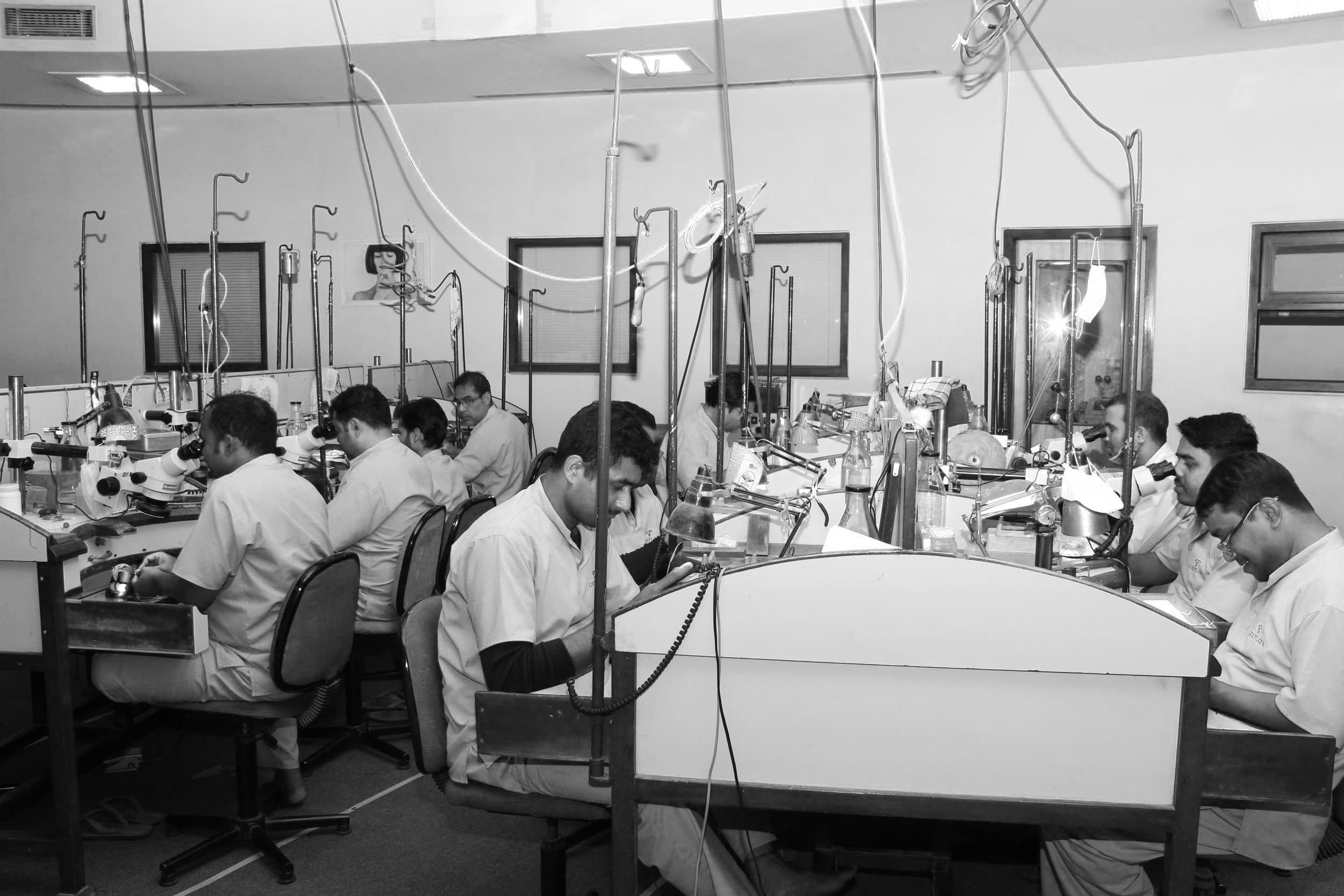
Jaipur is one of the few cities where the whole chain still exists inside a short drive — the goldsmiths, the enamellers, the setters and the stringers, all of them trained by someone who was trained by someone. It is not a heritage exercise. These are working trades with working apprentices, and the same benches that make jadau make contemporary settings on Monday morning.
We work in both directions. Some of what leaves our workshop is traditional jadau made the way it has always been made; some of it borrows the technique for something that would have made no sense in 1800. The Coloured Gemstones collection sits closer to the second, and the setters who make it are the same people who make the first. You can read about them on the atelier page, and if you are ordering a piece something, the choice between a claw setting and a kundan setting is one of the first decisions worth making, because it changes almost everything that follows.
A short glossary
- Polki — uncut or minimally cut natural diamond.
- Kundan — near-pure gold foil, cold-welded to hold a stone; also the name of the setting method.
- Jadau — the technique of embedding stones into a gold body using kundan.
- Meenakari — vitreous enamel fired onto gold, usually on the reverse.
- Lac — natural resin used to fill and support the gold shell.
- Ghaat, meenakar, jadiya, patua — the four crafts, in the order they work.
If a seller can explain those six words without hesitating, you are in a reasonable place. If they use all three of the first ones as though they meant the same thing, ask a second question.