Este artículo se publica únicamente en inglés.
Jaipur cuts coloured stones for the world. Rough arrives from Zambia, Colombia, Madagascar, Sri Lanka, Mozambique and Tanzania, is cut in workshops across the city, and leaves for Bangkok, Antwerp, New York and Geneva. A buyer standing in Johari Bazaar is standing at one end of that pipeline, which is an advantage and a hazard in roughly equal measure.
This guide is about the hazard.
The stones the city actually trades
Emerald is the one Jaipur is known for. The city's cutters have handled Colombian and Zambian rough for generations and the expertise is genuinely concentrated here. Emerald is a brittle, included stone and cutting it well is a judgement problem rather than a mechanical one.
Ruby and sapphire — corundum — in every colour the species produces. Blue sapphire from Sri Lanka and Madagascar, pink and yellow and the padparadscha range, and ruby from Mozambique and Myanmar. Jaipur trades a great deal of commercial-grade corundum alongside the fine material, and the two look far more similar in a shop light than they do in daylight.
Tanzanite, which comes from exactly one place on earth, a few square kilometres in northern Tanzania, and is almost always heated.
Tourmaline, including rubellite; garnet, including the tsavorite and spessartite ranges; aquamarine; peridot; and an enormous volume of quartz — amethyst, citrine, smoky — which is where a lot of tourist selling happens because the material is cheap and the names sound impressive.
And polki, uncut natural diamond, which is a category of its own.
Treatment is normal. Undisclosed treatment is not.
Almost every coloured stone on the market has been treated in some way. This is not a scandal; it has been true for centuries and the trade is built on it. What matters is that you know which treatment, and that the price reflects it.
Accepted and near-universal:
- Heating of sapphire and ruby, to improve colour and clarity. Stable, permanent, and expected. An unheated fine sapphire commands a large premium precisely because it is unusual.
- Oiling of emerald with clear oil or resin, to reduce the visibility of surface-reaching fractures. Also near-universal. Reports describe it as minor, moderate or significant, and that grading moves the price substantially.
Acceptable if disclosed and priced low:
- Glass-filling of ruby, where lead glass fills large fractures. The result is a stone that is structurally part glass, cannot be repaired conventionally, and can be damaged by an ordinary jeweller's torch. It is worth a small fraction of an untreated equivalent.
- Diffusion treatment, where colour is introduced into the surface layer of a stone at high temperature. It can be shallow enough to polish away.
- Dyeing, common in low-grade jadeite, turquoise and quartz.
The rule: ask what treatment is present, get the answer written on the invoice, and understand that a seller who says "no treatment" about an emerald is either mistaken or not telling you the truth.
What a laboratory report does and does not do
A gemmological report from an independent laboratory tells you three useful things: what the stone is, whether it is natural or synthetic, and what treatment has been detected. For an additional fee and only for certain species, it may offer an origin opinion — the geographic source — which is a probability judgement based on inclusions and trace chemistry, not a certainty.
A report does not tell you what the stone is worth. There is no price on it and there should not be. Valuation is a separate document, produced by a valuer, usually for insurance, and it is not evidence of a market price.
Two practical points. First, a laboratory owned by, or housed inside, the shop selling you the stone is not independent, whatever its letterhead says. Second, the report is issued for the stone in the photograph, with the measurements and weight stated; check that those match the stone you are being handed.
Price: what you are actually paying for
A coloured stone is priced almost entirely on colour, then on clarity relative to what is normal for that species, then on cut, then on weight — and weight is not linear. A five-carat stone of a given quality costs far more than five one-carat stones of the same quality, because large clean rough is rare.
For emerald specifically, the trade cares about hue and saturation before it cares about clarity, and an emerald with visible inclusions and superb colour will outprice a cleaner, paler one. This surprises people who have arrived with diamond assumptions.
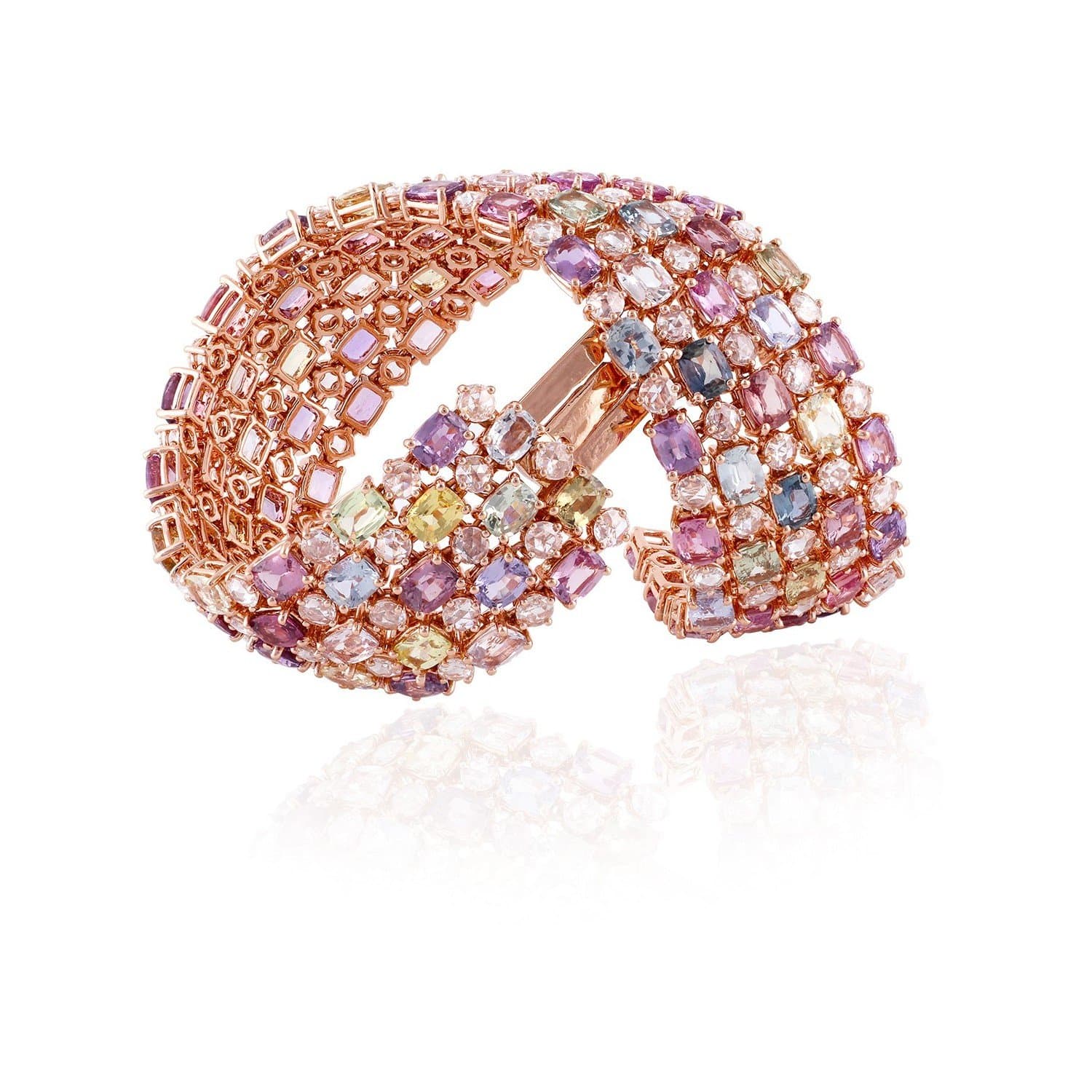
Ask for the stone and the making to be quoted separately. It is the fastest way to understand what you are being sold, and any house that manufactures its own work can do it without hesitating. We describe our own approach on the sourcing page, and you can see how the coloured material ends up in a finished piece in the Multi Sapphire collection or across our rings.
Eight questions worth asking
- What species is this, and is it natural?
- What treatment is present, and how would you describe its extent?
- Will you write both of those on the invoice?
- Is there a laboratory report, and which laboratory issued it?
- May I see the stone in daylight?
- What is the price of the stone, separately from the making?
- What is your policy if an independent laboratory disagrees with the description?
- Do you make the jewellery yourself, and can I see where?
The last question is not really about the stone. It is about whether the person selling it has anything to lose.
Two habits that cost visitors the most money
Buying through an intermediary. Drivers, guides and hotel staff in Jaipur are frequently paid a bespoke piece on what you spend, and it comes out of your purchase rather than the shop's margin. Twenty to forty per cent is typical. Choose where you go before you get in the car.
Buying in the first hour. Almost everyone who regrets a gemstone purchase bought it quickly, in a shop they did not choose, from someone who was very charming. The stones will still be there tomorrow. Look at four before you buy one, and look at each of them by a window.
And the thing that is genuinely worth doing here
See the work being done. Jaipur is one of a very small number of cities where you can watch a stone being cut, watch it being set, and meet both people in the same afternoon. That is the part of the city that is not available anywhere else, and it is a far better reason to buy here than any discount.