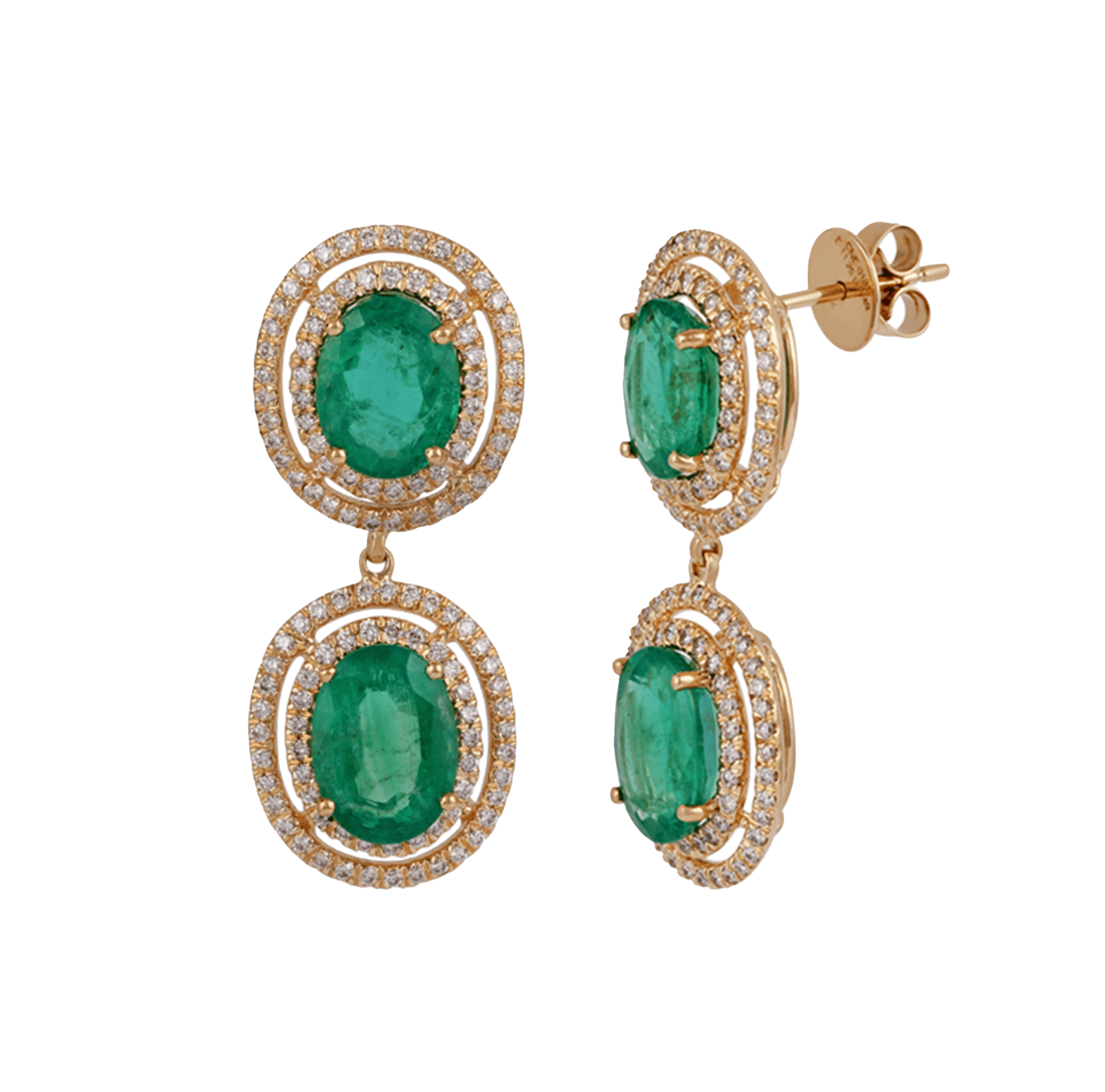
Este artículo se publica únicamente en inglés.
Ask a room of jewellers which emerald is better and you will get an argument rather than an answer. That is because the question is badly formed. Colombia and Zambia produce different stones, both of which can be superb and both of which can be dull, and the useful comparison is between specific stones rather than between countries.
Still, the deposits do differ, and the differences are real enough to be worth understanding before you spend money.
Two geologies
Colombian emerald forms in a way that is close to unique. The deposits in the eastern Andes — Muzo, Chivor, Coscuez — occur in black shale sedimentary rock rather than in the pegmatites and schists that produce emerald almost everywhere else. Hydrothermal fluids moving through that shale carried the beryllium and chromium that make an emerald, and the resulting crystals took up chromium as the dominant colouring element with relatively little iron.
Zambian emerald, from the Kafubu area near Kitwe, formed in contact between pegmatite and beryllium-bearing schist. The chemistry there includes significantly more iron.
That single difference — iron — is most of what you are looking at.
What it looks like
Colombian emeralds run warm. The green leans slightly yellowish, with a softness in the way it holds light that the trade sometimes calls a glow. The finest Muzo material has a depth that is genuinely difficult to describe and easy to recognise once you have seen it beside something else. Colombian crystals are often more heavily included, because of how they grew.
Zambian emeralds run cool. The green leans bluish, the saturation is often higher, and the tone can be darker. Clarity is generally better: fewer and finer inclusions, more stones that are eye-clean. Iron both shifts the hue toward blue and slightly damps the fluorescent glow that Colombian material has.
Neither of those is a verdict. A pale, cloudy Colombian stone is a pale, cloudy stone. A saturated, well-cut Zambian emerald is a beautiful thing that will cost less than its Colombian equivalent, and for a great many buyers it is simply the better purchase.
Inclusions are not a defect here
Emerald is graded on a different clarity expectation from diamond, and it has to be. The stone forms in a turbulent environment and essentially all of it contains inclusions — the old French trade word for the internal landscape is jardin, garden, which is a fair description of what you see under a loupe.
An emerald with no visible inclusions at all is unusual enough to raise a question rather than settle one. What matters is whether the inclusions interrupt the colour, whether they reach the surface in a way that threatens the stone's durability, and where they sit relative to the table.
Colour comes first. In practice the trade will accept a more included emerald with superb colour over a cleaner one that is paler, and price it accordingly. This is the opposite of the instinct most people bring from buying diamonds.
Oil, resin, and honest description
Because emerald grows with surface-reaching fractures, the trade has filled them for centuries — traditionally with cedarwood oil, now often with clear polymer resin. This reduces the visibility of the fractures by matching their refractive index more closely to the stone.
It is universal, it is accepted, and it is disclosed. Laboratory reports grade the extent as none, minor, moderate or significant, and that grading moves the price a great deal. Oil is not permanent; it can dry or be removed by ultrasonic cleaning, which is why emerald should never go near an ultrasonic bath and why a stone may need re-oiling at some point in its life.
What is not acceptable is filling with dyed material, which colours the fractures as well as hiding them. Any report will identify it.
Practical rule: an invoice for a significant emerald should state the treatment in words. If it does not, ask for it in writing before you pay.
Why the cutting happens in Jaipur
Rough from both Colombia and Zambia is routinely flown to Jaipur to be cut, and has been for a long time. There are three reasons and none of them are romantic.
Skill concentration. Emerald is brittle, cleaves readily and is full of internal stress. Cutting it is a judgement exercise: where to open a facet, which inclusion to cut around and which to leave, how much weight to sacrifice to get the colour to sit right. Jaipur has more people who have made that judgement ten thousand times than anywhere else.
Volume. The city handles a large enough throughput that a cutter sees the full range of material — good rough, difficult rough, rough that another centre would have written off — and learns from all of it.
Proximity to setting. The cutter, the setter and the enameller are in the same city, often in the same industrial zone. A stone that needs a fractionally deeper seat, or a recut after a setting decision changes, does not cross an ocean to get it.
The Zambian trade in particular runs largely through auctions in Singapore and Lusaka into Jaipur; a substantial share of Colombian rough arrives here too, sometimes by way of Bogotá and sometimes not.
How we choose
We buy for hue before size. The stones that go into the Emerald collection are selected for a green that holds its colour under warm indoor light as well as under daylight, because that is where jewellery is worn — a stone that only performs under a cool showroom spot will disappoint every evening of its life.
Origin is stated where we know it and where a laboratory has given an opinion. Where we do not know, we say so. Our approach to that is set out on the sourcing page, and the finished work runs through our necklaces as well as the earrings and rings in the collection.
If you are choosing between two emeralds and one is Colombian, put the papers face down and look at them in a window. Buy the one you keep looking at.