Este artículo se publica únicamente en inglés.
People imagine a bespoke piece as a long act of making. It is not. Most of it is deciding, and the deciding has to happen in a particular order, because every choice narrows the ones after it. Once the decisions are made, the making is quick, sequential and largely irreversible.
What follows is the shape of a bespoke piece at our atelier. The stages are fixed; the calendar is not.
Before anything: the conversation
The first meeting is not about design. It is about what the piece is for, who will wear it, on what occasions, over what kind of clothing, and — the question people find strangest — what they already own and never wear, and why.
That last one is the most useful question in the room. Almost everyone has a piece they were given or chose in a hurry that sits in a drawer, and the reason is almost always the same three things: it is too tall, it is too heavy, or the colour is wrong against their skin. Knowing which of those it was prevents the piece from repeating it.
We also establish the budget here, out loud, in a number. It is not indelicate; it is the only way to know which stones to look for.
Stage one — the stone
For a coloured-stone piece, everything starts with the material. We do not design a setting and then find something to put in it, because a design drawn around an imaginary stone will always fit the real one badly.
Finding the right stone can take an afternoon or several weeks. Jaipur helps: the material is here, and we can put four or five candidates on the table for comparison rather than describing one. You will see them in daylight by a window and under warm light, because they will not look the same, and the one that wins under the showroom spot is frequently not the one you should buy.
For diamonds we search our own stock and the live trade feed described on our diamonds page, and every stone arrives with its laboratory report before anyone commits.
Stage two — drawing
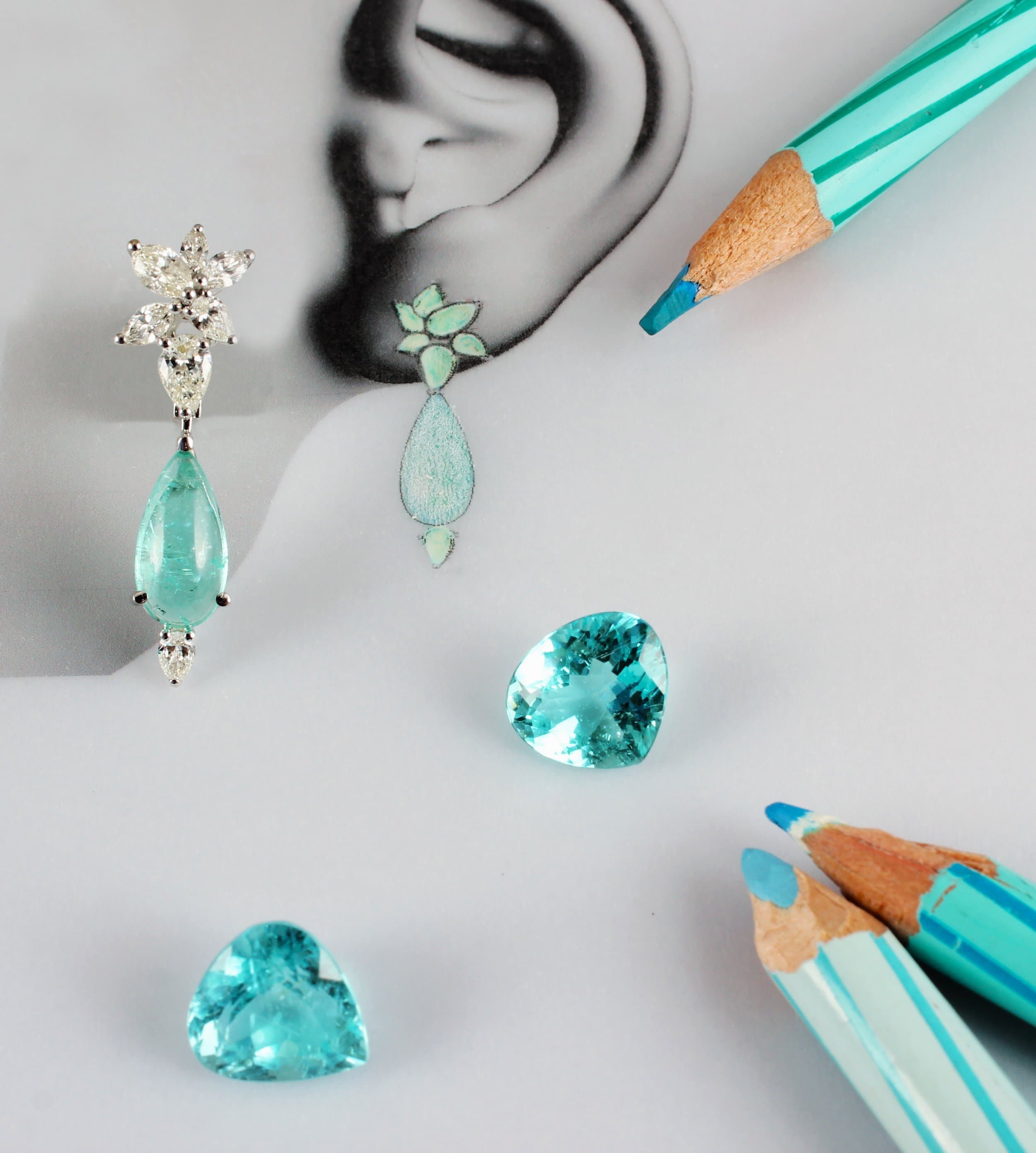
The first drawings are done by hand, in gouache, on card. This is not nostalgia. A gouache rendering shows how a piece will actually read — the density of the metal, how the light sits on a curve, whether the proportions work at the size they will really be — in a way that a rendered image does not, because a rendering flatters everything equally.
Two or three directions, usually. You will hate one of them, which is useful information.
The drawing is done at the true size of the finished piece, and a surprising number of bespoke pieces change substantially at this point, when a client sees for the first time that the necklace they described is physically larger than they imagined.
Stage three — CAD
The chosen drawing goes to the CAD station, where it becomes a three-dimensional model with real dimensions: metal thickness, seat depth for each stone, the height of the setting above the finger, gallery clearance underneath so the piece can be cleaned.
This is the stage where the engineering questions get settled. How much metal is under the stone. Whether the shank can be resized later without cutting through a set section. Where the weight sits, because a pendant that hangs a degree off vertical will do it forever.
You see the model from several angles before it is approved.
Stage four — wax and casting
The model is grown in wax or resin on a 3D printer, and this is the moment to come to the workshop if you can. A wax is the first time the piece exists as an object you can hold, and it is the last point at which changing your mind costs almost nothing. After casting, a change means starting again.
The wax is then invested in plaster, burned out, and the cavity filled with gold or platinum — lost-wax casting, the same process in principle that has been used for four thousand years, executed with a vacuum casting machine.
The rough casting comes out looking nothing like the finished piece. It is grey, granular and slightly frightening. That is normal.
Stage five — the bench
Filing, sanding, pre-polishing, assembly of any moving or articulated parts. This is where the piece stops being a casting and becomes jewellery, and it is entirely hand work.
If the piece is enamelled, the meenakari happens now, before any stone goes in, because the kiln temperature would destroy them. That sequence is not negotiable and it is why enamelled pieces are planned differently from the start.
Stage six — setting
The setter cuts the seat for each stone into the metal and closes the metal over it. For a single centre stone this is a few hours of very precise work. For a pavé surround it is days, one stone at a time, under a microscope, with the difference between a good line and a mediocre one measured in fractions of a millimetre.
This is the stage where the difference between workshops is most visible, and the easiest one for a buyer to inspect afterwards: look at the stones under a loupe and see whether they sit at exactly the same height and angle, and whether the metal between them is even.
Stage seven — finishing and checking
Final polishing, rhodium plating on white gold if the piece calls for it, hallmarking, and quality control. QC means the piece goes back to a bench that did not make it, and someone whose job is to find fault looks at it under magnification, weighs it, checks it against the CAD model and against the drawing, and tests every stone for movement.
Pieces come back from QC. That is what it is for.
What you receive
The piece, its laboratory reports where the stones carry them, the gouache rendering, and a written description of the materials and the making. The rendering matters more than people expect — twenty years later it is the only record of what the thing was meant to be.
If you want to see the building where this happens before you commit to anything, the workshop is about thirty minutes from the showroom. It is open to clients by appointment, Monday to Saturday. Existing work that shows the range of what the bench does is in the Coloured Gemstones collection, and the piece process itself starts on the bespoke page.